Özlem Eren, Ph.D. candidate, published a new article that is out in Canadian-American Slavic Studies, Volume 60, Issue 1-2 (May 2026), titled “Romanesque Façades as a Signal of Connection: Halych-Volhynia, Hungary and Poland in the 12th-Century European Network.” Open Access thanks to the Transformative Agreement between the University of Wisconsin-Madison and De Gruyter Brill.

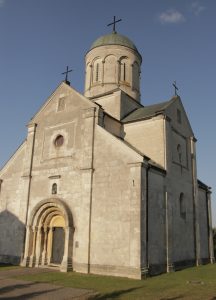
In her article, Eren demonstrates how Romanesque church façades in Halych-Volhynia (present-day Ukraine), Hungary, and Poland signaled participation in broader Christian and cultural networks in 12th-century Europe. Focusing on the Church of St. Panteleimon (ca. 1188-1193) in the modern western Ukrainian village of Shevchenkove in the Ivano-Frankivsk Oblast’, the primary surviving example of the architecture of the 12th-century medieval Rus’ Principality of Halych, she shows how architecture itself became a diplomatic tool and a visual language that expressed political, religious, and cultural affiliation.
The conspicuously noticeable Romanesque architectural elements on the exterior walls of St. Panteleimon, such as the round-headed portals with carved relief sculpture along the archivolts, carved capitals and columns, signaled being part of the broader networks of international medieval European kingdoms. A central argument of the article concerns the symbolic role of the knotted columns on the western portal. The knotted columns on the western portal carried a dual meaning: while evoking associations with Western Romanesque architecture, they also reassured the Orthodox world that their identity is still Orthodox and this new sacred space is a new “Solomon’s Temple.” At the same time, the church interiors and the liturgy were Byzantine-inspired, which provided a legitimacy that came from belonging to a long-standing Eastern Orthodox Christian tradition. The presence of the knotted columns on the western portal, more so than ornamental vegetal scrolls, provides evidence for the deliberate ambiguity in expressing cultural affinities with the Latin West or the Orthodox East due to the knot motif’s complex symbolism. This strategic ambiguity in the façades of St. Panteleimon allowed Halych princes to present Halych as a European capital while maintaining a distinct Orthodox, particularly Slavic, identity.
In her broader dissertation project (forthcoming, Dec 2026), Eren argues that the artistic choices shaping architectural monuments in Vladimir-Suzdal, Galicia-Volhynia, and Novgorod were not incidental, but deliberate strategies employed by ruling elites to negotiate power and identity and to assert political authority within a complex and interconnected medieval world.
 Abstract:
Romanesque architectural details on the façades of the Church of St. Panteleimon in Halych, Ukraine (ca. 1188–1193), which included round-headed portals with carved relief sculpture along the arches, carved capitals and columns, demonstrate the selective adoption of Western Romanesque elements in the 12th-century Halych Principality. Comparative analysis of round-headed portals, carved leaves and knotted columns in contemporary churches across Hungary, Italy, and former Byzantine area suggests that these elements were part of broader cultural and architectural networks. In particular, the use of the knotted columns on the western portal, more so than ornamental vegetal scrolls, supports my argument for the deliberate ambiguity in expressing cultural affinities with the Latin West or the Orthodox East due to the knot motif ’s complex symbolism. This strategic ambiguity in the façades of St. Panteleimon allowed Halych princes to present Halych as a European capital while maintaining a distinct Orthodox, particularly Slavic, identity.